
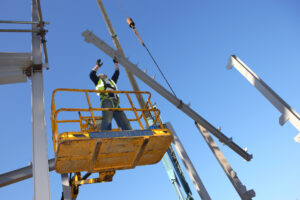
 Construction sites, industrial plants, and refineries are among the most dangerous workplaces in the country, and the accidents that happen there — falls from height, explosions, scaffolding collapses, crane failures — are responsible for some of the most severe spinal cord injuries our attorneys see. These aren’t ordinary workplace mishaps. The forces involved in a fall from several stories up, a plant explosion, or a collapsing structure are often catastrophic, and the injuries that result frequently require a lifetime of medical care. If you or a loved one has suffered a spinal cord injury in a workplace accident, understanding what compensation may be available — and from whom
In most states, workers’ compensation provides a baseline of coverage for medical costs and a portion of lost wages after a workplace injury, but it typically does not cover pain and suffering, and the benefits available often fall far short of what a catastrophic spinal cord injury actually costs over a lifetime. When a party other than your employer contributed to the accident, you may be able to pursue a separate personal injury claim in addition to workers’ compensation, which can provide meaningfully more complete compensation.
Common third parties in industrial and construction accident cases include:
Identifying every liable party matters enormously, since a workers’ compensation claim alone often becomes an artificial ceiling on what an injured worker is able to recover — even when someone else’s negligence made the accident far worse than it should have been.
Don’t Wait to Call an Attorney – Critical Evidence May “Get Lost”
Falls remain one of the leading causes of serious workplace injury, particularly in construction, and they’re one of the most common mechanisms behind severe spinal cord injuries in our caseload. A fall from a roof, ladder, or scaffolding can generate enough force on impact to fracture vertebrae and compress or sever the spinal cord, especially when proper fall protection wasn’t provided or wasn’t adequately enforced on the job site.
The severity of a fall-related spinal cord injury tends to depend on a few key factors:
Falls that involve a direct impact to the head, neck, or upper back are especially likely to result in quadriplegia, given the proximity of the impact to the cervical spine, while falls resulting in impact lower on the torso more often cause paraplegia. In many cases, safety violations — including OSHA violations — serve as powerful evidence of negligence that goes beyond the standard workers’ compensation framework and supports a separate third-party claim.
Refinery and industrial plant explosions represent some of the most catastrophic workplace accidents, frequently resulting in severe spinal cord injury, traumatic brain injury, or death. The force of an industrial explosion can throw workers significant distances, cause structural collapse on top of victims, or generate blast pressure severe enough to cause internal spinal trauma even without a direct physical impact.
These cases often involve complex investigations into:
Our attorneys have handled some of the largest plant explosion verdicts in the country, recovering tens of millions of dollars for families affected by these disasters — a track record documented on our page of past verdicts and results.
Scaffolding collapses and crane accidents present some of the highest-force injury scenarios on a construction site, and they frequently involve multiple potentially liable parties at once. A scaffolding collapse can result from improper assembly, inadequate load-bearing capacity, or a defective component, and workers on or beneath the structure at the time of collapse are at severe risk of spinal cord injury from both the fall itself and any structural material that comes down with it.
Crane accidents carry similarly serious risk, whether from a load drop, a structural failure of the crane itself, or a collapse of the crane during operation. Given the enormous weight and height involved in crane operations, injuries in these accidents are frequently among the most severe our attorneys handle, often resulting in complete spinal cord injuries rather than incomplete ones, given the extreme forces involved.
Beyond the specific scenarios above, spinal cord injuries in workplace settings frequently result from:
Workplace accident cases move quickly in ways that can affect the strength of a claim. Employers and their insurers often begin investigating an incident within hours, and evidence that could establish third-party liability — equipment maintenance logs, safety inspection records, surveillance footage, or witness statements — is not always something an injured worker or their family has access to on their own. An attorney experienced in industrial and construction accident cases knows what to request, how quickly to request it, and which regulatory records, such as OSHA citations or incident reports, can help establish that the accident resulted from more than an unavoidable workplace hazard.
Depending on the nature of the accident, an investigation may involve several types of evidence and expert analysis, including:
This kind of investigation often reveals whether an accident was truly unavoidable or whether it resulted from a preventable failure — a missed inspection, a shortcut on safety protocol, or a piece of equipment that should have been taken out of service. That distinction can be the difference between a workers’ compensation claim alone and a full third-party liability claim that reflects the true cost of a catastrophic injury.
When a workplace spinal cord injury may support both a workers’ compensation claim and a separate third-party liability claim, building the strongest possible case requires understanding what damages are recoverable under each, and how they interact. Compensation in a successful third-party claim can include:
Our attorneys evaluate every potentially liable party from the outset, ensuring that a workers’ comp claim doesn’t become the ceiling on what you’re able to recover when a third party’s negligence played a role. We also work with clients on cases across the country, and connect injured workers with the top spinal cord injury rehab hospitals nationwide to make sure medical care and legal strategy move forward together, not in competition with each other.
 Not every personal injury attorney has genuine experience navigating the overlap between workers’ compensation and third-party liability claims, and that overlap is exactly where the most significant compensation in a workplace spinal cord injury case is often found. An attorney unfamiliar with industrial and construction litigation may accept a workers’ comp settlement as the end of the road, when in fact it may only be the starting point for a much larger claim against a negligent equipment manufacturer, subcontractor, or property owner. Our attorneys have spent decades handling exactly this kind of case, and we know how to identify every avenue of compensation available to a worker who’s suffered a life-changing injury on the job.
If you or a loved one has suffered a spinal cord injury in an industrial accident, construction site fall, explosion, scaffolding collapse, or crane accident, contact our team today for a free, confidential case review. We’ll help determine whether your case extends beyond workers’ compensation to a full personal injury claim.
Request Your FREE CONSULTATION Today!
Call (800) 883-2020 or fill out the form below to contact our team.
WILLIS LAW FIRM 5005 Riverway Drive #160 Houston, Texas 77056 Principle Place of Business | Toll-Free (800) 883-2020 – Free Case Review – All Meetings By Appointment Only
The information on this website is for general information purposes only. Nothing on this site should be taken as legal advice for any individual case or situation. This information is not intended to create, and receipt or viewing does not constitute an attorney-client relationship.
Lastly, the list of past settlements listed on this site represents decades of the largest settlements for the catastrophically injured client(s) of the Ammons Law Firm and some past settlements of the Willis Law Firm. Upon written request, a breakdown of the attorney’s fees and expenses incurred along with the net settlement to the client are available.
© 2025 All Rights Reserved. Spinal Cord Injury Lawyers.